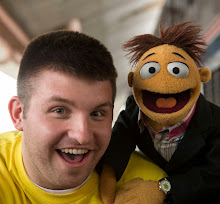
Today we have the start of yet another wonderful interview here on The Muppet Mindset. Earlier this week I had the distinct pleasure of sitting down for a phone call with veteran
 Sesame Street
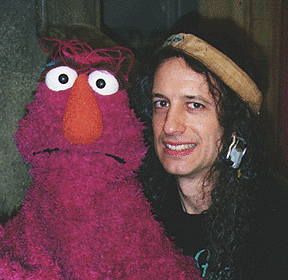
Muppeteerr Martin P. Robinson, performer of Telly Monster, Mr. Snuffleupagus, Slimey the Worm, and many others. Marty was kind enough to chat with me at length about his career, his characters, and his co-workers. At Marty's request, the phone interview is being presented here transcribed for you to read. This the first of a three part interview, so be sure to check back next week and the following week for even more wonderful insights from the mind of Marty.
Interview with Muppeteer Martin P. Robinson
conducted by Ryan Dosier

RYAN:
Greetings Muppet fans, it’s Ryan Dosier here once again for another interview. This time I’ve got one of the most talented and long-standing performers on Sesame Street: Martin P. Robinson. He performs Telly Monster and Mr. Snuffleupagus and Slimey the Worm and quite a few others, and we’ve got him here to ask him a few questions. Hi Marty!
MARTY: Thank you for that lovely introduction.
RYAN: Oh, you’re welcome! Let’s see... where should we start here?
MARTY: How can I serve you today?
RYAN: Um, do you have pizza? I’d love some.
MARTY: No, no I’ve raised three kids and I’ve got two more coming along and I’ve had my fill of pizza. If I never see another pizza for the rest of my life, I’d be okay. Plus, after all the work on Ninja Turtles we had pizza coming out of our ears.

RYAN: (laughs) I can imagine! Well I guess first we should start off by finding out a little bit about how you got started with Sesame Street and with Jim Henson and the Muppets all together.
MARTY: I had been in puppetry before that. I graduated from acting school and got some jobs with a puppet company. I was qualified because it was a touring company and I had a driver’s license so I was their man! I learned puppetry... you know, you go out on tour and you learn the puppetry or you go mad.
I started off with marionettes and then worked for Bill Baird’s marionettes after that. He always does a lot of different styles in his shows. He always mixed up marionettes with rod puppets, with handpuppets, with shadow puppets, blacklight puppets... whatever it took to tell the story. I had had some experience with hand puppetry by then and by the time I was asked to audition for the Muppets... I had sent them a picture and a resume. Back in the days when you actually had an 8x10 photo with a resume stapled onto the back! That was the extent of our electronic resumes.

And I sent it in, got a call about a year later. They were putting together kind of a cattle call just to see what was out there. And I got invited to a big audition for... I don’t know, a couple hundred people at the audition. Every day that you were invited back, there were fewer and fewer people until there were about ten of us and then there were five of us and it turned out that they were casting for Snuffleupagus. Jerry Nelson had hurt his back doing the character so they had somebody in the front of the character that wasn’t doing the voice and Jerry was doing it remotely, which isn’t the best way to do puppetry. The key to Muppets is you’re performing the little guy as you’re saying the lines, as you’re feeding the character, as you’re interacting with whoever you’re with. You know, it’s on the spot stuff. Plus, that way they had three people if they hired someone to go in, they only had to hire two people! So it made sense in a lot of ways.
So anyway, I was hired to do Snuffy in ’81 and then worked into a bunch of other characters from there. It was actually kind of lucky the way I did it because most folks, when they start at Sesame or, you know, at most jobs... they do right hands and background characters for years. Richard Hunt used to say... if anyone complained about not getting any characters, he would remind them that he did right hands for eight years before he was allowed to touch a main character.
While I was doing Snuffy I did Telly’s right hand for about three or four years until I took over the character. I did background character stuff, the way it was normally done, but I had this lead character too which was really nice.

But it worked out. As I told you before, I can’t look at anything I did in my first eight years. I was just competent enough to not get myself fired. (laughs) Which is sometimes all it takes until you really do learn the job. I finally kind of got the key to performing, which is no big secret. The key to performing is you just don’t worry about what you look like or how you’re coming across or what people might think of you. You just go for it, go for it one hundred percent. There’s all kinds of things that are available to you that were bumming you out and you think, “Oh, geez! Is that gonna look crazy? Is that gonna go too far?” No. There’s no such thing as too far. I’ve proved that over and over again in my life--in my professional and personal life. (laughs) And so it worked out! I took over Telly and some other characters when Brian Muehl quit and I’ve got a nice little stable of characters now. I’m very happy with that.
That’s how it worked out in a nutshell.
RYAN: Could you talk a little bit about working with Jim Henson and Jim Henson in general?

MARTY: You know... it’s a lovely, kind of tough subject. You know we still miss him, it’s still like, “Oh, God what if, what if?” Working with him was always great. Whenever he came in it was something special. He was there at the auditions and it was
great. Just great having Jim be the one that saw my work and invited me to come be a part of the company. It didn’t matter what project he was working on, what film, what big huge deals... when he came to Sesame Street he was like--I mean, I didn’t know Jim in the old days, but I got a feeling that that’s what it was. People who knew him in the old days refer to it that way. He was just another one of the guys, one of the grunt puppeteers just having a ball, doing what he did when he started it all.
The people he surrounded himself with, as Jon Stone said at Jim’s funeral--Jon Stone was one of the great movers and shakers and creative forces behind Sesame... one of my personal favorite people in the entire world, so anything he said meant something to me. But he said that the people that Jim surrounded himself with... it was no accident that we were there, that were there because he wanted us to be there because he had chosen us in one way or another. It was a bunch of crazy people with somewhat the same mindset as him and he was certainly iconoclastic in the way that he was and crazy and nutty and irreverent in that way.
You had to be on your game when he was there. You absolutely had to be on your game! But one the whole points of being on your game is have fun. Not being tense, just being free. Free to react to something new and throw something new back and to come up with something a little better, perhaps, then it was intended to. Jim always told us that if you only do a script the way it’s written, the way it’s presented to you, then we haven’t done our job. That our job was to make it better, make it more, certainly make it physically funny and translate the written word into physical comedy, physical communication of useful... type. (laughs)

It was great working with him. He was a man of very few words. It’s kind of legendary the way he would look at bits afterwards. He’d nod a little bit and if he said, “Hmmm...” that means you were doing it again. If he nodded a little bit more and said, “Mmmm! Nice.” then we might keep that one. And if he said, “Mmm! Lovely!” then you were movin’ on! He taught by example in a lot of ways to young ones that had a lot of enthusiasm but not a lot of experience.
RYAN: Well... sort of on the opposite end of the spectrum--not the opposite really, just another spectrum entirely--
MARTY: Who was the worst person I worked with?! Let me see...
RYAN: (laughs) Well I was going to ask about Richard Hunt, so...

MARTY: Oh! He was... I wouldn’t say on the other side of the spectrum, but he was definitely on another spectrum! Again, one of my favorite people in the entire world. Really influential. Richard, on the other hand, was there all the time. He was rough on new puppeteers. Strangely enough, he didn’t have a
huge amount of respect for puppetry. He kind of wanted to do other things himself, and you really had to prove yourself to him. Anyone who was a real Muppet enthusiast and wanted to be there to meet “Mr. Henson” and “work Muppets,” he wouldn’t give you the time of day if you were that kid. If you showed any whiff of ego around him, that’s it, he would knock you down. Certainly with the things he said and ‘cause he was a big powerful man, he would stick an elbow in your eye just as soon as look at you.
If you passed muster with him then you were golden, then you were part of the fun. He was great. It was Little Shop of Horrors, I think, that got him to actually speak to me. He kind of realized that I had something going besides being a little Muppet fan. I was always a big fan of the Muppets. I saw them on The Ed Sullivan Show when I was a kid... but I wasn’t a huge Muppet fan. I was really honored to have an audition with them and I was really honored to be hired by them, but it wasn’t a life-long ambition. When Richard came backstage after he saw Little Shop of Horrors, he just loved the show and saw that it was something very much involved in puppetry but not Muppet style.
RYAN: I want to talk a little bit about Snuffy now, because he’s one of my favorites and I’m sure he’s one of yours.
MARTY: Well sure.
RYAN: There have to be some physical challenges with that massive costume, puppet going on over all the time. Could you talk a little bit about that?

MARTY: Yeah... it’s big and heavy and dark. And dangerous to a certain extent, when I started it Jerry Nelson had hurt his back doing it. I knew this and didn’t want to hurt my back doing it, so I readjusted the weight so that it was on my hips and legs. It has a metal frame backpack/harness inside... I think it’s like a steady-cam harness that they put in there. I adjusted it so that the belt was around my hips, on my pelvis, so that most of the weight was from there down, not on my spine at all. Maybe twenty-five, thirty percent of the weight was on my shoulders and back, just enough to steer it and move it and to focus the head.
As long as you respect the creature, he’ll do good by you. I always warm up before I go inside so that I’m stretched out and warmed up. I don’t mind working hot. Working hot is much better than working cold, it’s much safer. Once I heat up in a scene, as soon as I come out I bundle up with a thick warm up jacket to stay warm so that I don’t get cooled off before I go back inside again. We’re in and out. You do a rehearsal, you’re out. Sometimes we’ll do a rehearsal then shoot it and then come out. My record for being inside is five and a half hours... that was during the Follow That Bird film. Which was on a film schedule and it was in a really difficult position. It’s not a record I intend to beat ever. Generally we don’t stay in more than twenty minutes to half an hour, forty five minutes sometimes. Usually it’s fifteen minutes or less, then we hang it up.

Even though I have more of the weight in front, I can stand up straight and I’m in a stronger position to carry it. Bryant Young, who does the back, has less weight, but he has to do it with rounded shoulders and a curved back. He has to really be careful. But he’s an accomplished dancer and choreographer, so he’s never had any injuries in there either. Actually, he’s been doing it longer than I have. He did it the season before I started. He’s a great guy, he’s the unsung hero of the whole creature. He’s got to know when I’m gonna go and know which foot I’m gonna start with, keep the pull going to the back, and I kind of keep the pull going to the front... Anyway, it’s a tough job, but we really enjoy each others company.
We have monitors inside of course so we can see what the camera see. I also can see out the mouth for when we get off camera. Because, of course, once you get off camera you’d be blind to keep from trampling children or tripping over wires.
RYAN: That would be a good thing not to do.
MARTY: Yeah... “Child Trampled by Snuffleupagus.”
RYAN: I can see the headlines now! What’s your favorite aspect of Snuffy’s character and his personality?

MARTY: Oh, he’s very sweet, very unassuming. He doesn’t have a lot of subterfuge going on. He’s just kind of a simple character. He doesn’t see a lot of cruelty, he just doesn’t understand it, doesn’t see it, doesn’t experience it. So like Oscar, is cruel as he wants to Snuffy and Snuffy does not get it. And you know, it’s naïve to a certain extent, I wouldn’t say stupid, but one might. He’s just young and very naïve.
I love his relationship with Bird, of course. The two of them... Jon Stone used to call them “Dumb and Dumber.” Bird would say something just patently useless and Snuffy would go, (Snuffy voice) “Hmm, sounds like a good idea to me, Bird!” And they’d go off following this bad train of thought. That’s the kind of stuff I like.
But Snuff kind of has what I typify as tunnel vision. He’s kind of straight forward and things are a certain way and there’s a lot of things that he just doesn’t see.
RYAN: How about your favorite Snuffy moments on the show? I know there are so many, but...
MARTY: Snuffy moments... wow. Goodness. You know, they put Snuffy in a lot of crazy situations--bounce him on trampolines, and making believe he’s a cloud and flying off, and doing all kinds of nutty things to him. My favorite stuff is the really good character stuff with Bird, when he and Bird are going off on flights of fancy sometimes. We did a show where they were kind of making believe they were explorers and they were just going down the street and they would look at the trees and they saw a fancy tree, or they’d look at a bug and oh! It’s this great incredible bug. And every person that they’d meet they’d look at them in a whole new way. Very sweet, very typical of that age type of show.
RYAN: What about Slimey? Because here we’ve got you performing the largest the character and the very smallest.
MARTY: The largest Muppet and the smallest! It’s a fun range to do, especially when you do it all in one day. Although there have been some scripts with Slimey and Snuffy together then I have to give up Slimey. I can’t ask anyone else, of course, to climb in the Snuffleupagus.

Slimey’s a very sweet character I really enjoy. It’s the simplest little thing, just those two tiny little wires on the bottom with a little mouth trigger. And he’s essentially silent, with little squeaks and pops and stuff that he does. The fun of him is getting all that character out of a puppet that is the simplest thing in the world--and then with no voice. So he’s really kind of eloquent in his silence, but his moves have to be very clearly, very specific. Just spot-on with the tiniest little twitches in your fingers to convey his thought process. It’s quite a challenge going from a whole-body experience with Snuff--two people’s whole body--to just the tiniest little twitch of a wire, just a millimeter up and a millimeter twist to the left, look to the camera with the tiniest little mouth twitch just means a whole lot. You have to be very specific, very clear, very clean with the movements.
But character-wise, the best thing he does on the show, I think, is reveal Oscar. He reveals Oscar’s golden heart. ‘Cause Oscar just loves him, he’s devoted to him. Sometimes he treats him off-handedly kind of like a pet, but he’s not, he’s a child. In reality, Oscar is sometimes almost Slimey’s child, because Slimey’s sophisticated in his own way, but Oscar treats him like a little kid, reads for him, tucks him in. He just cares for him more than anything. It really reveals Oscar’s inner warmth, which is great. It’s the best service he can provide pretty much.

In years past they would always do big, huge Slimey episodes--whole series of episodes. The whole going to the moon thing was a whole series of episodes, at least ten shows in that season were devoted to that. The whole process of being chosen, and the whole training process, and being shot up, then going there, and Tony Bennett singing “Slimey to the Moon” on the rooftop of the building to the kids, and then the whole thing of them being there, then the splashdown coming back--those were all separate shows. We did the big rock concert with worms, we did the big worm World Cup match, we did the winter Olympics, we did... God, so many worm things. Oh! Stock-car racing--just major, major worm shows. We haven’t done so many recently. In the last couple of years there haven’t been too many Slimey shows--certainly none of that magnitude.
Check back next week for Part 2 of our interview with Martin P. Robinson where he discusses Telly at length and a whole lot more.
This interview would not have been possible if not for the kindness of Patrick Cotnoir, to whom I owe immeasurable thanks. Thank you, Patrick! Hope you're enjoying it.
The Muppet Mindset by Ryan Dosier, muppetmindset@gmail.com


 Performed by...
 Alice Snuffleupagus is the baby sister of... well, you can probably guess. She popped up at her brother’s side on Sesame Street during the show’s 19th season and remained a prominent character for the next several. Speaking strictly in babyish phrases of two or three words maximum, little Alice is sweet and curious, if mischievous and naïve.
 Perpetually two years of age, Alice is one of the youngest residents of the street. As a result, she, like many young children, struggles with using her manners and communicating. Luckily, Alice is growing up on Sesame Street. Here, with help from Snuffy and their many neighbors, she is learning new words, concepts, and social behaviors every day, in addition to having a lot of fun, just like a good percentage of the viewership. Talk about relating to your audience!
 Alice is almost never without her older brother, Aloysius Snuffleupagus. The two are very close, even as Alice’s inexperience and desire to mimic Snuffy frustrate him occasionally. Yet, they have a lot of love for each other, and the mutualistic relationship provides Snuffy an opportunity be a leader and teacher, while Alice gets to learn about the world. The pair dance, roller skate, recite the alphabet, explore, and play together, and neither would have it any other way.
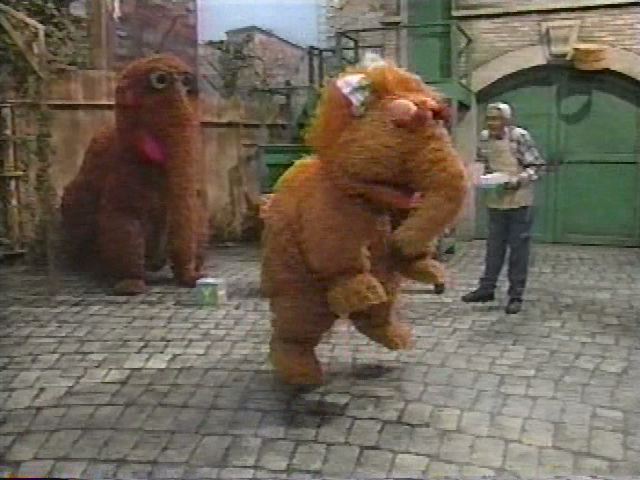 A handful of episodes, as well as a good number of storybooks, had plots centered on Alice. Episode 3781 featured the little Snuffleupagus learning how to control the air puffs coming from her trunk. In episode 2621, Snuffy and Big Bird become devoted to creating a baby book for Alice. Alice and her brother were babysat in episode 3524, while episode 3775 focused on Alice’s throwing of temper tantrums, and her subsequent ending of the behavior.
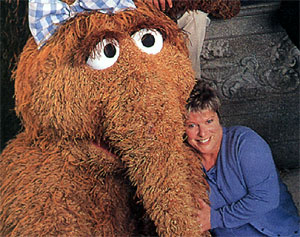 Because Alice is so small, she isn’t performed like the other Snuffleupagi, with one performer each in the front and the rear. She requires only one puppeteer, Judy Sladky, who buckles herself into the costume and then crawls around on all fours, operating the mouth and doing the voice when necessary. The blinks and rolls of Alice’s long-lashed eyes are controlled via radio control from across the room. As far as performing full-body Muppets go, Judy Sladky has an exceptionally difficult job, for there is no room in the suit for a monitor on which she can view her progress.
 Alice hasn’t been seen on Sesame Street since Season 31, and it’s really a shame. An important part of Sesame Street is exploring various relationships, and Alice and Snuffy are the best examples of young sibling interaction that you will find on the show. Whether a child viewer is the older or younger sibling in their particular relationship, they can identify easily with the Snuffleupagus siblings and their misadventures.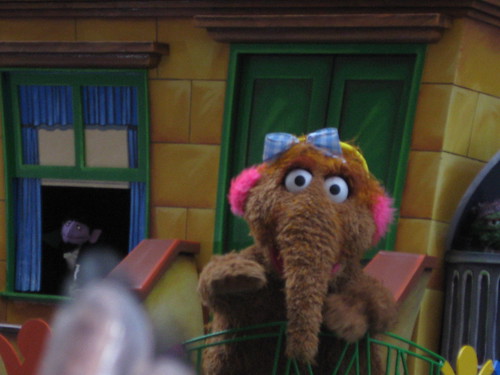








.jpg)